

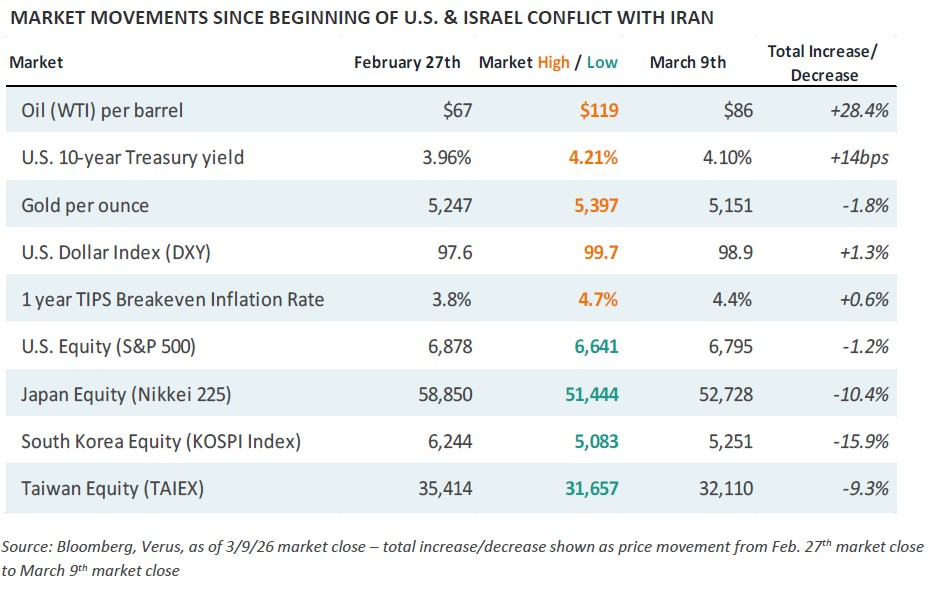
Market movements since the February 28th U.S. and Israel strike on Iran have overall been fairly mild, although certain regions and commodity markets have shown substantial stress. Iranian attacks on oil tankers and energy infrastructure of its neighbors, and the effective closure of the Strait of Hormuz, created intense uncertainty around global oil production and supply which sent the price of crude oil to $119 in futures trading over the weekend. Investors rushed into haven assets which pushed up the U.S. dollar, while the U.S. 10-year Treasury yield headed upward (rather than downward) likely due to inflation fears and the possibility that the Federal Reserve puts rate cuts on pause. Meanwhile, regional equity markets of countries that are highly dependent on energy imports, such as Japan, South Korea, and Taiwan, suffered losses.
In this week’s Market Note, we illustrate market movements that have occurred during the conflict. Price pressures eased somewhat near the end of the trading day on Monday following President Trump’s comments that the war could soon be over, and that the U.S. is considering taking control of the Strait of Hormuz.
The Verus Market Note provides market commentary along with relevant charts and graphs. Each week, we highlight a key story from the finance world that we believe will pique your interest. While these insights are meant to inform and enrich your understanding of the current market landscape, they should not be taken as direct recommendations for immediate portfolio adjustments.